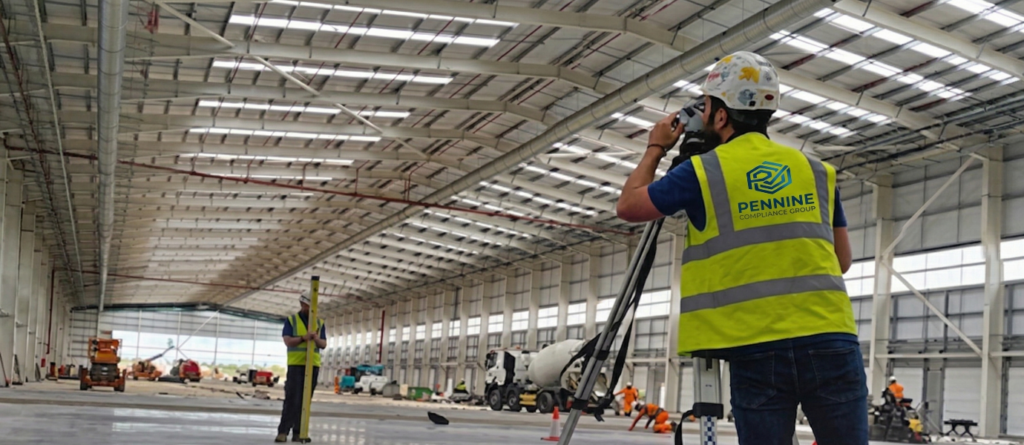
Pennine Compliance provides independent, high-accuracy surveying for Defined Movement (DM) and Free Movement (FM) environments. We ensure your facility meets The Concrete Society’s TR34 standards and major international specifications to maximize operational efficiency and safety.
Core Surveying Capabilities
We specialize in the two distinct types of warehouse traffic movement:
Defined Movement (DM)
Essential for Very Narrow Aisle (VNA) racking systems. We measure the fixed pathways used by MHE to ensure the high standard of flatness required for high-lift safety and efficiency.
Defined Movement (DM) Classifications: TR34 (4th Edition)
In accordance with The Concrete Society’s Technical Report No. 34 (4th Edition), specifically Section 3 regarding Very Narrow Aisle (VNA) warehouse floors, we adhere to the following flatness requirements and permissible limits. These classifications ensure operational efficiency and safety based on the height of your racking system.
Permissible Limits for Defined-Movement Areas
The choice of classification is primarily dependent upon the racking top beam height. The limits below for and are calculated based on a fixed longitudinal dimension of 2000mm.
Free Movement (FM)
For areas where traffic moves randomly in any direction (loading bays, wide aisles, or block stacking). We use representative grid sampling to ensure the entire floor area meets compliance.

Defined Movement (DM): VNA Warehousing
Essential for Very Narrow Aisle (VNA) racking, we measure fixed pathways to ensure the high level of flatness required for high-lift safety. In accordance with TR34 (4th Edition), we monitor key properties including:
- Property Z: Transverse dimension between front wheel centers.
- Property Z_SLOPE: Cross-aisle slope in mm/m.
- Property dZ & dX: Elevational differences between wheels and axles.
| Floor Classification | Racking top beam height | Property Z_SLOPE | Property dZ | Property d²Z | Property dX | Property d²X |
|---|---|---|---|---|---|---|
| Calculation | – | mm per m | Z x Z_SLOPE | dZ x 0.75 | Fixed values 2 x Z_SLOPE x 1.1 | Fixed values |
| DM1 | Over 13m | 1.3 | Z x 1.3 | Z x 1.0 | 2.9 | 1.5 |
| DM2 | 8 – 13m | 2.0 | Z x 2.0 | Z x 1.5 | 4.4 | 2.0 |
| DM3 | Up to 8m | 2.5 | Z x 2.5 | Z x 1.9 | 5.5 | 2.5 |


Free Movement (FM)
For areas where traffic moves randomly in any direction (loading bays, wide aisles, or block stacking). We use representative grid sampling to ensure the entire floor area meets compliance.
The Concrete Society’s TR34 Free Movement (4th Edition) Classifications
For loading bays and wide aisles where traffic moves randomly, we assess surface regularity using a representative 3-meter grid sample.
- Property E: Controls levelness (elevational difference between 3m grid points).
- Property F: Controls flatness (change in elevation over 300mm).
- Compliance: No point on the Property E grid should exceed +/- 15mm from the datum.
Permissible 95 percentile values on Properties E and F.
| Floor Class | Typical floor use | Property E | Property F |
|---|---|---|---|
| FM1 | Where very high standards of flatness and levelness are required. Reach trucks operating at above 13m without side-shift. | 4.5 | 1.8 |
| FM2 | Reach trucks operating at above 8 – 13m without side-shift. | 6.5 | 2.0 |
| FM3 | Retail floors to take directly applied flooring. Reach trucks operating at up to 8m without side-shift. Reach trucks operating at up to 13m with side-shift. | 8.0 | 2.2 |
| FM4 | Retail floors to take applied screeds. Workshops and manufacturing facilities where MHE lift heights are restricted to 4m. | 10.0 | 2.4 |
Note: Side-shift is the ability of a truck to adjust the pallet transversely to the fork direction.
Properties E and F are checked as well as a check to datum
Property E to control levelness is the elevational difference in millimetres checked directly between fixed points 3m apart on a grid over the entire floor area. (not across diagonals)
Property F to control flatness, this is the change in elevational difference between two consecutive measurements of elevational difference each measured over 300mm.
No point on the Property E survey grid is to exceed +/- 15mm of a fixed datum plane.
Topographical Surveys
With over 20 years of experience, Pennine Compliance specialises in delivering precise topographical plans tailored to your specific project requirements. Trusted by clients across the UK, our expert team provides bespoke quotations within 48 hours, ensuring your development stays on schedule.
- ISO 9001 Certified: Our processes meet international standards for Quality Assurance.
- Expert Team: Highly skilled specialists dedicated to technical accuracy.
- Fully In-House: We manage every stage of the survey internally for better control and reliability.
- Nationwide Coverage: Professional surveying services available throughout the UK.
What is a Topographical Survey?
A Topographical Survey provides detailed mapping of a property’s physical features, covering both natural and man-made elements. By capturing the land’s terrain, shape, and elevation, we produce a comprehensive 3D representation of the surface.
Our surveys include critical data such as:
- Contours and Slopes: Visualising the gradient and shape of the land.
- Existing Structures: Accurate positioning of buildings, roads, and utilities.
- Environmental Features: Detailed mapping of vegetation, water bodies, and other significant site landmarks.
Whether you are in the planning, design, or construction phase, our topographical data ensures your project is built on a foundation of professional accuracy.
Surface Regularity – Straightedge Method
The current method is described in BS 8204 Screeds, bases and in situ floorings, which uses a 2m long straightedge placed directly in contact with the surface and the maximum deviations below the straightedge recorded. It assesses the local variability in surface plane in a 2m gauge length. There are in theory an infinite number of locations the straight edge could be placed on the floor.
Although this can assess the localised variation in plane in a 2m length it does not assess the rate of change in variation or ‘waviness’ of the surface, i.e. does not differentiate between long, medium and short wavelength variations. For example a corrugated surface could meet a straight edge tolerance but clearly the surface would not be flat.
Note that BS 8204: part 1 Annex C.2 Methods of assessment of levels and surface regularity states “Where the straight edge basis for specification is used it is advisable for the various interested parties in a contract to agree a sampling rate for testing the concrete base … before the concrete base …is constructed. Such agreement should include the number of positions where the straight edge will be placed to check conformity.”
Straightedge Method
We conduct compliance testing using the 2m straightedge method for retail units or mezzanine decks. We test for:
- SR1: 3mm deviation
- SR2: 5mm deviation
- SR3: 10mm deviation
Recommended Sampling: If the rate is not specified, we suggest: Floor Area m² / 20 = Minimum number of tests.

Surface regularity can be checked with the use of a straight edge.
This method of testing is described in both BS 8204-Part 1:2003 and BS 8204-Part 2:2003. A 2m straight edge is used in both specifications. These are usually but not always specified on mezzanine decks or retail units where tiling is to be received.
Basic Method of Measuring Surface Regularity
- A 2m straight edge is placed in contact with the floor and resting under its own weight.
- Measure the greatest gap from the underside of the straight edge, between the points which are in contact with the floor surface. This is done by means of a ‘go’ ‘no go’ method. The measurements are taken by means of a slip gauge.
It should be noted that both British standards state that ‘Where the straight edge basis for specification is used it is advisable for the various interested parties in a contract to agree the sampling rate for testing the floor to check conformity, and the procedures to adopt if conformity is not achieved, before the floor is constructed. Such agreement should include the number of positions where the straight edge will be placed to check conformity’
If the rate of testing is not known, then we would recommend the following formula to calculate the minimum number of straight edge tests.
Floor area M²/20 = Minimum number of straight edge tests.
Specialized Robotics & Automated Testing
As logistics evolves, so do floor requirements. We offer specialized testing for:
- Goods to Person (G2P) Robotics
- Autonomous Mobile Robots (AMR)
- Automated Storage and Retrieval Systems (ASRS)

Why Precision Flatness Matters
Achieving the required surface regularity is a business-critical investment. Our surveys help you ensure:
- Maximum Speed: Lift trucks can operate at full design speed without vibration.
- Reduced Costs: Lower downtime and maintenance on expensive MHE fleets.
- Enhanced Safety: Significant reduction in driver fatigue and “static lean” (where floor errors are magnified at the top of a high mast).
- Asset Protection: Minimized damage to stock and pallets.
Technical Standards & Professional Assurance
As a Tech CIOB qualified firm and a member of the Concrete Society, we deliver independent, data-driven results to all major global specifications:
- UK: TR34 (Properties E & F), BS 8204
- USA: ASTM E 1155, ACI F-min
- Europe: EN 15620, DIN 15185, DIN 18202, and VDMA
We utilize the latest digital testing technology—including advanced rolling profilers and laser-based sensors—to provide sub-millimetre accuracy. Unlike slower, traditional methods, our digital approach provides rapid data turnaround, allowing for immediate analysis of your floor’s performance.

Diverse Sector Experience
Pennine Compliance Group brings technical rigor to a wide variety of environments, including:
- Logistics & Distribution Warehouses
- Data Centres & Cold Storage
- Film & TV Studios
- Sports Facilities (Velodromes & Stadiums)
- Transport Hubs & Railway Platforms
Consult an Expert
Whether you are a developer, contractor, or facility manager, we offer professional advice on all concrete floor tolerances.
Contact Pennine Compliance Group today to book a survey or discuss your project requirements.
Speak to a Specialist
If your warehouse floor needs to meet The Concrete Society’s TR34 Free Movement classification—whether FM1, FM2, FM3, or FM4—contact Pennine Compliance Group today to speak with one of our concrete flooring specialists.
With extensive experience in surface regularity and floor flatness, we are your trusted partners in delivering first-class compliance solutions for free movement warehouses. We ensure your facility meets the permissible limits and property standards required for optimal operational efficiency.
Email: info@penninecompliancegroup.com
Phone: 07765 365 370